
Quick answer: AI crawlers from companies like OpenAI, Anthropic, and Google now make up a large share of web traffic—sometimes 20% or more for content-heavy sites. This bot surge strains servers, slows page speed for real visitors, and inflates bandwidth costs. To protect performance, sites need stronger hosting, smart crawler controls, and caching.
Your site loads fine. Your hosting plan looks solid. But your bandwidth bill is climbing—and you don’t know why.
Here’s the reason. AI bots are crawling your pages around the clock. They feed large language models like ChatGPT, Claude, and Gemini with fresh content. Every crawl uses your server resources. And unlike human visitors, these bots never stop.
This post breaks down how AI crawler traffic affects your website speed, what it does to your hosting needs, and how to stay fast without overpaying. You’ll get clear, practical steps you can act on today.
What Are AI Bots and Why Are They Crawling Your Site?
AI bots are automated programs that scan and collect web content. They feed that content into AI models for training and real-time answers.
The big names include GPTBot (OpenAI), ClaudeBot (Anthropic), Google-Extended (Google), and PerplexityBot (Perplexity). Each one visits your pages to read your text, follow your links, and pull your data.
Why does this matter to you? Because every visit costs you. Server processing, bandwidth, and database queries all get consumed—whether a human ever sees the page or not.
Traditional search crawlers like Googlebot have done this for years. The difference now is scale. AI companies are racing to index the entire web, and they’re hitting your site harder and more often.
How Much Traffic Do AI Crawlers Actually Generate?
A lot. And it’s growing fast.
Reports from infrastructure providers show AI bots can account for a significant slice of total site requests—often between 10% and 30% for content-rich websites. Some publishers have reported even higher spikes during aggressive crawl periods.
Cloudflare data from 2024 found that AI crawlers were among the fastest-growing bot categories on the web. GPTBot alone became one of the most active crawlers within months of its launch.
Think about what that means. If one in five requests comes from a bot, you’re paying to serve content to machines—not customers.
That’s wasted capacity. And it gets worse during traffic peaks.
How AI Crawler Traffic Slows Down Your Website
Speed is money. Google’s Core Web Vitals—the metrics that measure load speed, responsiveness, and visual stability—directly affect your search rankings and conversions. Slow pages push customers away.
Here’s how bots hurt your speed:
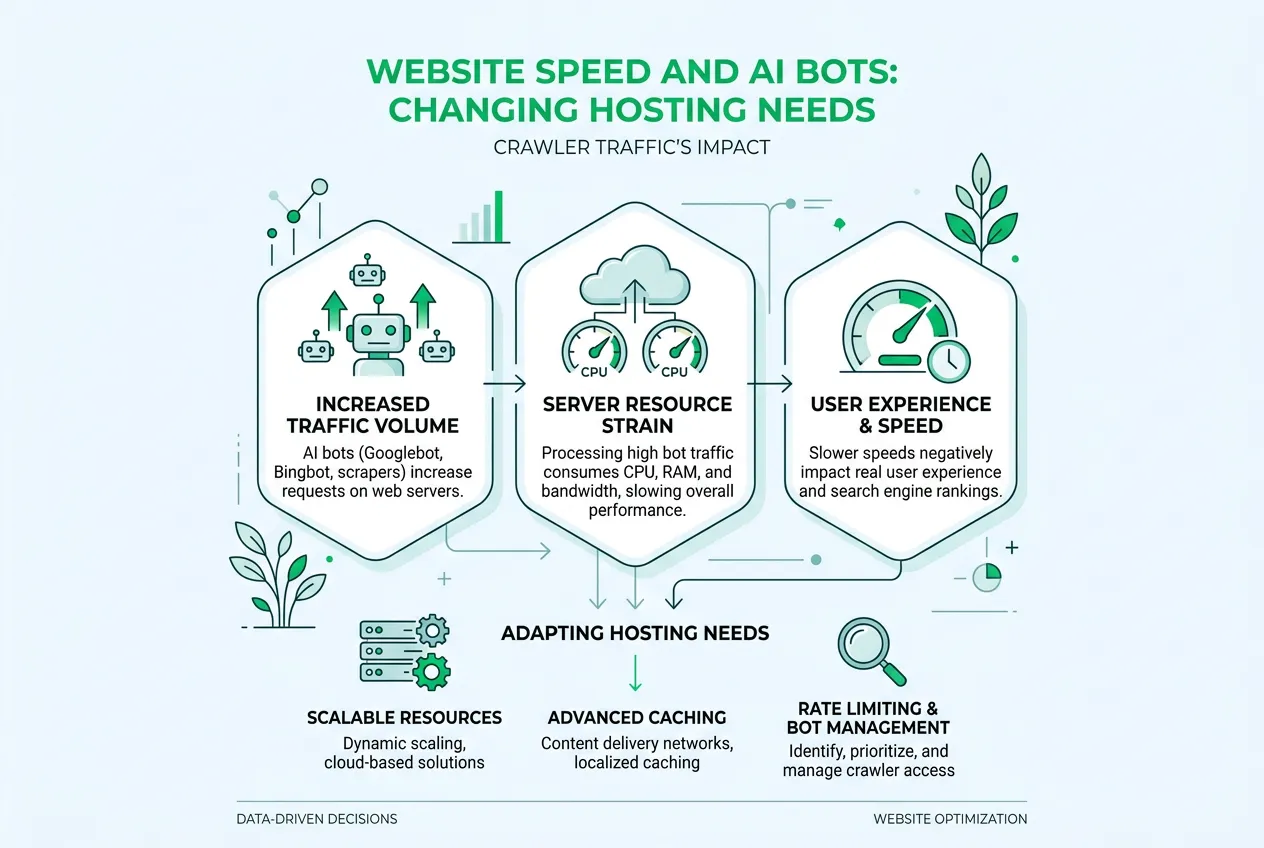
They compete for server resources. Every bot request uses CPU and memory. When bots crawl aggressively, your server has less power left for real visitors. Pages load slower. Some time out completely.
They hammer your database. Many AI crawlers ignore static caches and request fresh, dynamic pages. Each one triggers a database query. Pile up enough of these, and your database chokes.
They spike during the worst moments. Bots don’t check whether you’re having a busy sales day. A crawl surge during peak human traffic can tip a healthy server into overload.
The result is simple. Your customers wait. Your bounce rate climbs. Your sales drop.
What This Means for Your Hosting Needs
Old hosting math doesn’t work anymore.
You used to size your hosting around human visitors. Now you have to plan for bots too—and bots can outnumber people on content-heavy sites.
Here’s what changes.
You need more bandwidth headroom. Bot traffic eats into your monthly transfer limits. Cheap shared plans with tight caps will fail you. Budget for the extra load.
You need scalable resources. Fixed servers buckle under crawl spikes. Cloud hosting or autoscaling setups handle sudden surges without crashing. They flex up when bots arrive and flex back down after.
You need stronger caching. A good caching layer serves stored copies of your pages instead of rebuilding them every time. This cuts server strain from repeat crawls dramatically.
You need a CDN. A content delivery network spreads your content across global servers. It absorbs bot traffic at the edge—before it ever touches your origin server.
Pick the setup that matches your traffic. Run a content-heavy site that bots love? Prioritize scalable cloud hosting and a strong CDN. Run a small brochure site? Solid managed hosting with caching may be enough.
How to Control AI Bot Traffic Without Hurting Your SEO
You can’t block every bot. Some help you. Googlebot ranks your pages. AI crawlers can surface your brand in AI answers.
But you can manage them. Here’s how.
Use robots.txt. This file tells crawlers what they can and can’t access. You can allow Googlebot while blocking GPTBot, or limit which sections bots reach. Just know that not every bot obeys the rules.
Set crawl-delay where supported. Some crawlers respect a delay instruction that spaces out their requests. This eases the load without a full block.
Rate-limit at the server. For bots that ignore robots.txt, set hard limits on requests per IP. Your firewall or CDN can enforce this.
Use bot management tools. Services like Cloudflare offer controls that identify AI crawlers and let you allow, throttle, or block them by name.
Decide based on your goals. Want visibility in AI answers? Allow the major AI bots but throttle them. Want to protect proprietary content? Block the bots that train on your data.
Keep Your Site Fast in the Age of AI Crawlers
AI bots aren’t going away. They’re multiplying. And they’ll keep pulling on your server every day.
The fix isn’t to panic. It’s to plan.
Right-size your hosting. Add caching and a CDN. Manage your crawlers with intent. Do these three things, and your site stays fast—for the customers who matter.
Check your bot traffic this week. Your server logs hold the answer.
Frequently Asked Questions
Share this article
Follow us
A quick overview of the topics covered in this article.
Latest articles
June 24, 2026
June 21, 2026

April 20, 2026

Latest Articles & Insights
Actionable insights on SEO, web design, and digital growth—focused on what works to drive traffic, leads, and real results.
SEO vs. Paid Ads: Which Grows a Small Business Faster?
June 29, 2026
6 min
Quick answer: Paid ads generate traffic within hours of launch. SEO takes three to six months ...
SEO for CCTV Companies in Saudi Arabia
June 24, 2026
6 min
Quick answer: SEO for CCTV companies in Saudi Arabia means optimizing your website to rank for ...
Website speed and AI bots: how crawler traffic is changing hosting needs
June 22, 2026
6 min
Quick answer: AI crawlers from companies like OpenAI, Anthropic, and Google now make up a large ...
Why your WordPress site needs structured data more than ever (for AI crawlers)
June 21, 2026
5 min
Quick answer: Structured data is code that tells AI crawlers exactly what your content means. Without ...