SEO vs. Paid Ads: Which Grows a Small Business Faster?
Paid ads can put you in front of buyers within hours. SEO takes months, but it keeps working after you stop paying. Here's an honest look at both, and a simple way to decide what to fund first.
- Published
- Updated
- Reading time
- 6 min
Quick answer
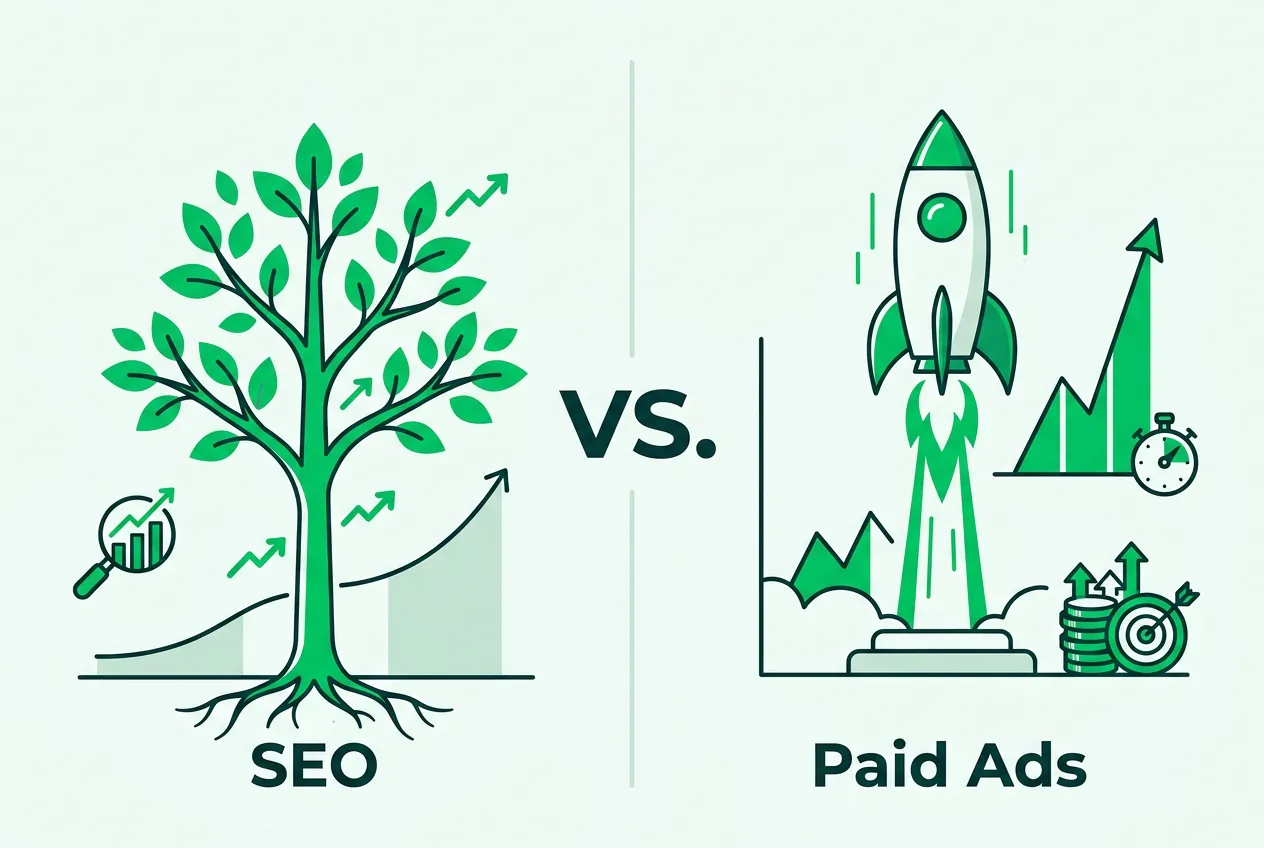
Paid ads can bring visitors within hours of approval, but the traffic stops the day your budget does. SEO is slower. Google's own guidance puts the usual wait at four months to a year before the work pays off1, yet a page that ranks keeps working without a cost per click. For most small businesses the practical answer is both: ads for enquiries now, SEO so you depend on ads less over time.
On this page
Your budget is limited and every dirham or riyal has to work. So when you're deciding between SEO and paid ads, the wrong call can cost you months of momentum.
Both channels bring traffic, and both can bring leads. They just run on different timelines, cost structures and risks. Below you'll find how each one behaves for a small business, a side-by-side comparison, and a straightforward way to decide what to fund first.
How quickly do paid ads deliver results?
Fast. That's the honest answer.
Launch a Google Search campaign today and, once your ads are approved, they can appear in front of buyers within hours. You set the budget, choose the locations and searches you want to show up for, and traffic flows for as long as you keep paying.
For a product launch, a seasonal push or a slow quarter, that speed solves the immediate problem. Google Ads and Meta Ads also let you target by location, audience and search intent in ways organic search can't match in the short term.
The catch is that every click has a price, and the moment you stop paying, the traffic stops. Before you commit a budget, check what clicks cost in your own city and industry: Google's free Keyword Planner shows estimated bid ranges for the locations you choose2.
One myth worth clearing up: buying ads doesn't lift your unpaid rankings. Google states that advertising with it has no effect on how your site appears in organic results, and that it never takes money to rank a site there1.
Paid ads are powerful. They're also a tap, not a well.
How long does SEO take to show results?
Longer than most people want to hear.
SEO (search engine optimisation) is the work of improving your website so it ranks higher in Google's unpaid results. Done well, it puts you in front of people who are already searching for what you offer, without paying for each visit.
Google's own guidance puts the usual wait at four months to a year between starting the changes and seeing the benefit1. Competitive searches can take longer, because Google has to crawl your pages, understand them and weigh them against everything else competing for the same results.
The payoff works differently, though. Pause an ad campaign and its traffic ends that day. A page that ranks can keep bringing visitors long after the work is done, although rankings are never guaranteed and need looking after. That slow start is SEO's weakness early on, and its strength later.
SEO vs. paid ads, side by side
Here's how the two channels compare on the points that matter most to a small business.
| Factor | SEO | Paid ads |
|---|---|---|
| Time to first results | Usually months. Google's estimate is four months to a year | Hours to days, once ads are approved |
| How you pay | Your time or an agency fee. No cost per click | You pay for every click (or impression) |
| When you stop | Rankings can hold for a while, but aren't guaranteed | Traffic stops immediately |
| Labelled as an ad | No | Yes |
| Targeting | The searches and topics your pages cover | Location, audience, device, schedule and keywords |
| Best for | Long-term visibility and authority | Enquiries now, launches, testing an offer |
| Scaling up | More useful pages and authority, no extra cost per visit | More budget |
Neither channel wins outright. The right choice depends on your timeline, your budget and where your business is today.
Which should a small business prioritise first?
It comes down to one question: do you need leads this month, or are you building for the next twelve?
For most small businesses the best answer is both: run ads to bring in revenue now, invest steadily in SEO, and move budget across as organic enquiries grow.
Practical tip
Run a small, tightly targeted ads campaign first and note which searches actually turn into enquiries. Those searches are strong candidates for your first SEO pages.
Build the part that lasts
Paid ads get you in the room. SEO keeps you there.
A campaign that runs out of budget leaves nothing behind. A page that ranks keeps working while you're with a client or on holiday. The businesses that grow steadily use paid channels to fund the time SEO needs to compound, and they measure both honestly.
Key takeaways
- Paid ads can bring visitors within hours of approval, but the traffic stops the day the budget does.
- SEO usually takes four months to a year to pay off, by Google's own estimate, and keeps working after the effort stops.
- Buying ads doesn't improve your unpaid rankings. The two are separate.
- Need enquiries this month? Start with ads. Can you wait six months or more? Put SEO first.
- For most small businesses, running both works best, moving budget toward SEO as organic enquiries grow.
Frequently asked questions
How long does SEO take to work for a small business?
Google's guidance is four months to a year from starting the work to seeing the benefit1. Local searches with little competition can move faster; competitive national searches usually take longer. Be wary of anyone who promises page one within weeks.
Are Google Ads worth it on a tight budget?
They can be, if the campaign is narrow: high-intent searches, one location, one clear offer, and a landing page built to convert. Check estimated click costs for your area in Keyword Planner first2, so you know how many clicks your budget can realistically buy.
How much does SEO cost for a small business?
It depends on the scope of work, how competitive your market is and who does it, so treat any quoted "average" with caution. Ask for a fixed-scope proposal that lists the deliverables and what you'll see in each monthly report.
Can a small business do SEO without an agency?
Yes, especially local SEO. Complete your Google Business Profile, collect genuine reviews, keep your business name, address and phone number the same everywhere, and publish pages that answer real customer questions. For technical problems or competitive markets, professional help can speed things up.
Which gives a better return long term, SEO or paid ads?
It depends on your market and your margins, and neither is guaranteed. SEO often lowers the cost per lead over time because the traffic doesn't stop when spending does. Paid ads are faster and more predictable, but you pay for every click. Many businesses get the best result from both.
Sources & references
Every figure in this article links to where it came from. Links last checked 25 September 2026.

About the author
About SEORTIX
SEORTIX is an SEO and web development agency, founded in 2019. We work remotely with businesses across the GCC and worldwide, and we write about what we do every day: SEO, visibility in AI search, and websites built to rank.
How we write
- Every statistic links to its original source.
- Examples come from real work, shared with the client's permission.
- When facts change, we update the article and show the new date.
Not sure where your budget should go first?
Send us your website and tell us about your market. We'll look at both and tell you honestly whether ads, SEO or a mix makes sense for you right now.